Your dentist tells you a tooth needs attention. They mention either a filling or a crown. You nod, make the appointment, and head home. Somewhere on the way back you realise you are not entirely sure why it is one and not the other.
It is a very common experience. The difference between the two treatments is not always explained clearly in the consulting room, and the terminology can feel interchangeable when you are not familiar with it. But the decision follows a clear clinical logic, and understanding it helps you feel confident about your treatment plan, ask better questions, and make sense of why the recommendation has been made.
What Is a Filling and What Does It Actually Do?
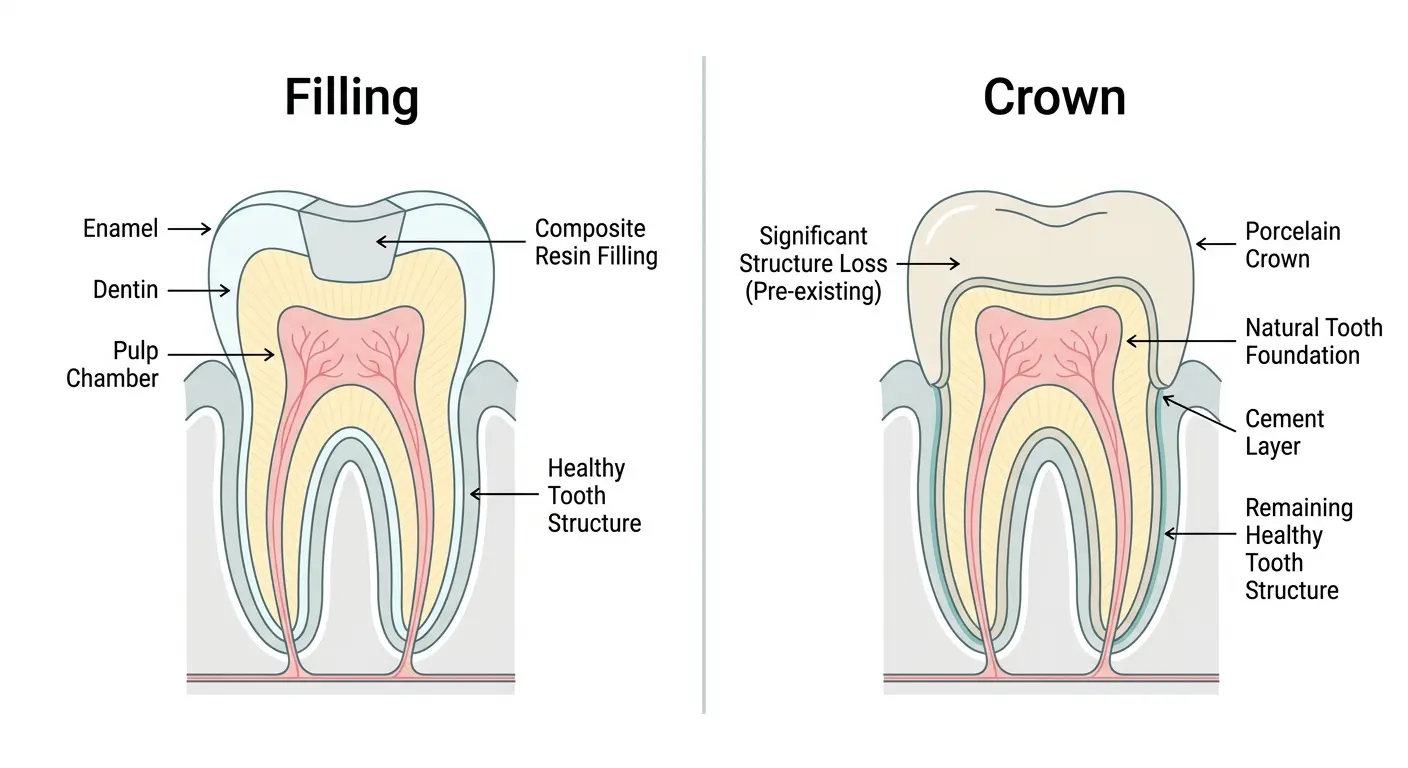
A filling restores a tooth by replacing the material lost to decay or minor damage. Once a dentist removes the affected tissue, the resulting cavity is filled with a tooth-coloured composite resin, shaped, set, and polished to restore the tooth's function.
The critical factor is what surrounds the filling. For a filling to work reliably over the long term, there needs to be enough healthy tooth structure on all sides to hold it in place and withstand the pressure of everyday biting and chewing. If the walls of the tooth are intact and sound, a filling is typically the right solution.
Image Filename: dental-filling-cross-section-diagram-llanelli.webp Alt text: Diagram showing a dental filling in a tooth, relevant to general dentistry at Lotus Dental Studio in Llanelli
What Is a Dental Crown and When Is It Used?
A dental crown, sometimes called a cap, is a custom-made covering that fits over the entire visible portion of a tooth above the gumline. Rather than filling a cavity within the tooth, a crown encases the tooth completely, redistributing the forces of biting and chewing across the whole structure rather than relying on whatever natural walls remain.
Crowns are used when a tooth has been too significantly damaged or decayed for a filling to provide reliable, lasting restoration. They are also the standard recommendation following root canal treatment, where the treated tooth becomes more brittle and needs the protection of a crown to remain functional long term.
At Lotus Dental Studio in Llanelli, dental crown treatment uses porcelain and ceramic materials matched to the shade of your natural teeth, so the result looks and feels like part of your smile.
The Key Difference: It Comes Down to How Much Tooth Remains
The decision between a filling and a crown is determined primarily by how much healthy tooth structure is left after decay or damage is removed.
If the majority of the tooth's natural structure is intact, the walls are solid and the damage is contained, a filling is usually the appropriate choice. The tooth can support it, and the filling will hold up under normal bite pressure.
If decay or damage has compromised a significant portion of the tooth, or if the remaining walls are too thin to withstand chewing forces without risk of fracture, a crown becomes necessary. The crown takes over the structural role that the natural tooth can no longer fulfil on its own.
There is also a longer-term consideration worth understanding. A tooth that has already had a large filling does not stay in that state indefinitely. Fillings wear over time, and a tooth that has been repaired multiple times may eventually reach a point where there is simply not enough sound material remaining for another filling to be placed reliably. In that situation, a crown is not an escalation. It is the more sensible, durable long-term solution.
When a Filling Is Likely the Right Choice
A filling is typically the recommended treatment when decay is caught early and the damage is limited. If a routine check-up identifies a small to moderate cavity, or if a minor chip or crack has not compromised the bulk of the tooth, a filling will restore it effectively. A tooth that has lost an old filling but still has sound structure surrounding the cavity is also a straightforward filling case.
This is one of the clearest reasons why regular dental check-ups have a practical impact on your treatment costs. Decay that is caught at the filling stage is quicker to treat, less invasive, and significantly less expensive than decay that has been left to progress to the point where a crown is required. Routine check-ups at Lotus Dental Studio are specifically designed to catch problems at the stage where they are simplest to fix.
When a Crown Is Likely the Right Choice
A crown becomes the appropriate recommendation when the scale of damage moves beyond what a filling can reliably restore. Extensive decay that has destroyed a large portion of the tooth, a deep crack with thin remaining walls, or a broken cusp that a filling cannot adequately replace are all situations where a crown is the right tool for the job.
A tooth that has undergone root canal treatment almost always needs a crown afterwards. The procedure removes the pulp from inside the tooth, which leaves the remaining structure more brittle than a living tooth. Without a crown to protect it, the tooth is significantly more vulnerable to fracture under everyday use.
Similarly, a very large old filling that has failed, where removing it leaves insufficient tooth structure to support a replacement, will typically require a crown rather than another filling. This is not a sign that something has gone wrong. It is a natural progression for a tooth that has been heavily restored over many years.
Can a Dentist Tell Which You Need Before They Start?
Usually yes, but not always with complete certainty until treatment is underway.
X-rays provide a strong indication of how extensive the decay is, and in most cases a dentist can give you a clear recommendation before starting. However, X-rays show the extent of decay in two dimensions, and the full picture only becomes clear once the damaged tissue has been removed. Decay can sometimes be deeper or wider than it initially appears, which is why some patients come in expecting a filling and leave having been told a crown is needed.
This is not an unexpected development or an upsell. It is a normal feature of dental treatment. Once decay is removed, the dentist assesses what remains and recommends the most appropriate restoration for what they find. If a filling was planned and a crown is needed, your dentist will explain why before proceeding.
Does It Matter Which Material the Crown Is Made From?
Crown materials have evolved considerably, and the material used affects both the appearance and longevity of the restoration.
At Lotus Dental Studio, crowns are made from porcelain or ceramic, tooth-coloured materials that blend naturally with surrounding teeth and reflect light in a way that closely mimics natural enamel. These are the standard for most visible teeth. The choice of material, and any nuances relevant to your specific tooth and bite, will be discussed at your appointment so you can make an informed decision.
How Much Does a Crown Cost Compared to a Filling and Is Finance Available?
A crown costs more than a filling because it is a more involved restoration, custom-made in a dental laboratory to fit your tooth precisely and requiring two appointments in most cases. The difference in cost reflects the difference in complexity.
For current pricing on both fillings and crowns, the most accurate reference is the fees page at Lotus Dental Studio. Patients on the Dental Care Plan receive reduced fees on treatments, and 0% finance over 12 months is available for those who prefer to spread the cost.
What Should You Do If You Think You Need Either Treatment?
Book an appointment and do not put it off. A small cavity that needs a filling today does not stay small. Decay progresses, and the longer it is left, the more tooth structure is lost. What is a straightforward filling appointment now can become a crown-level problem if it is deferred for months.
Lotus Dental Studio sees patients from across Llanelli, South Wales, and Carmarthenshire. Whether you have been told you need work done, have noticed sensitivity or damage, or simply have not been to the dentist in a while, the right step is to get it assessed.
Book Your Appointment Book online at lotusdental.co.uk or call 01554 774 509
Clinically reviewed by Khawaja Jawad Fariduddin, BDS | Principal Dentist at Lotus Dental Studio, Llanelli. GDC registered.