If you've recently lost a tooth — or you're facing an extraction — one of the first questions you'll ask is: what now? Two of the most popular tooth replacement options are dental implants and dental bridges. Both will restore your smile and your ability to eat and speak comfortably. But they work in fundamentally different ways, and the right choice depends entirely on your individual situation.
At Lotus Dental Studio in Llanelli, we offer both treatments. This guide walks you through how each one works, the honest pros and cons of each, and the questions that should shape your decision.
What Is a Dental Bridge?
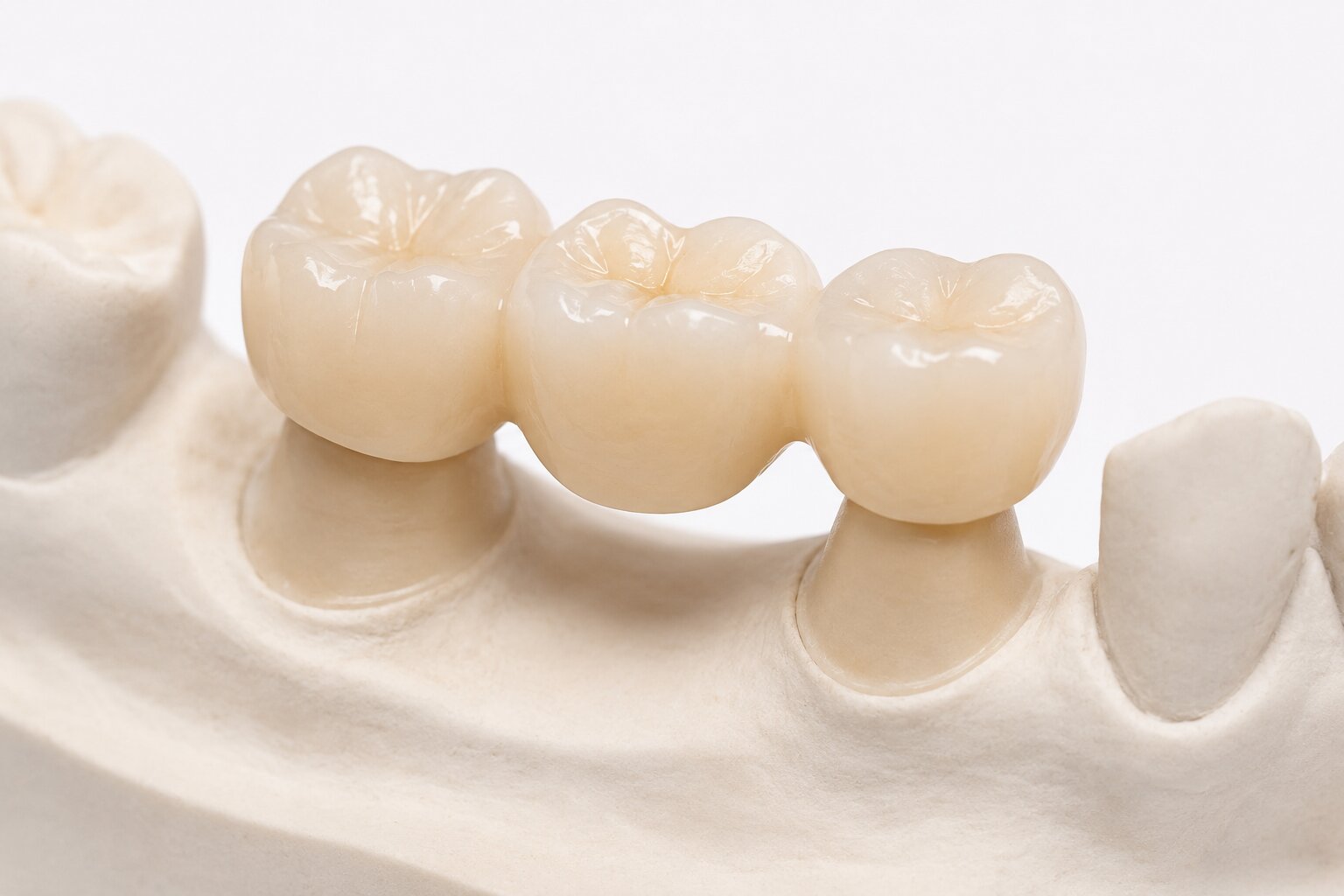
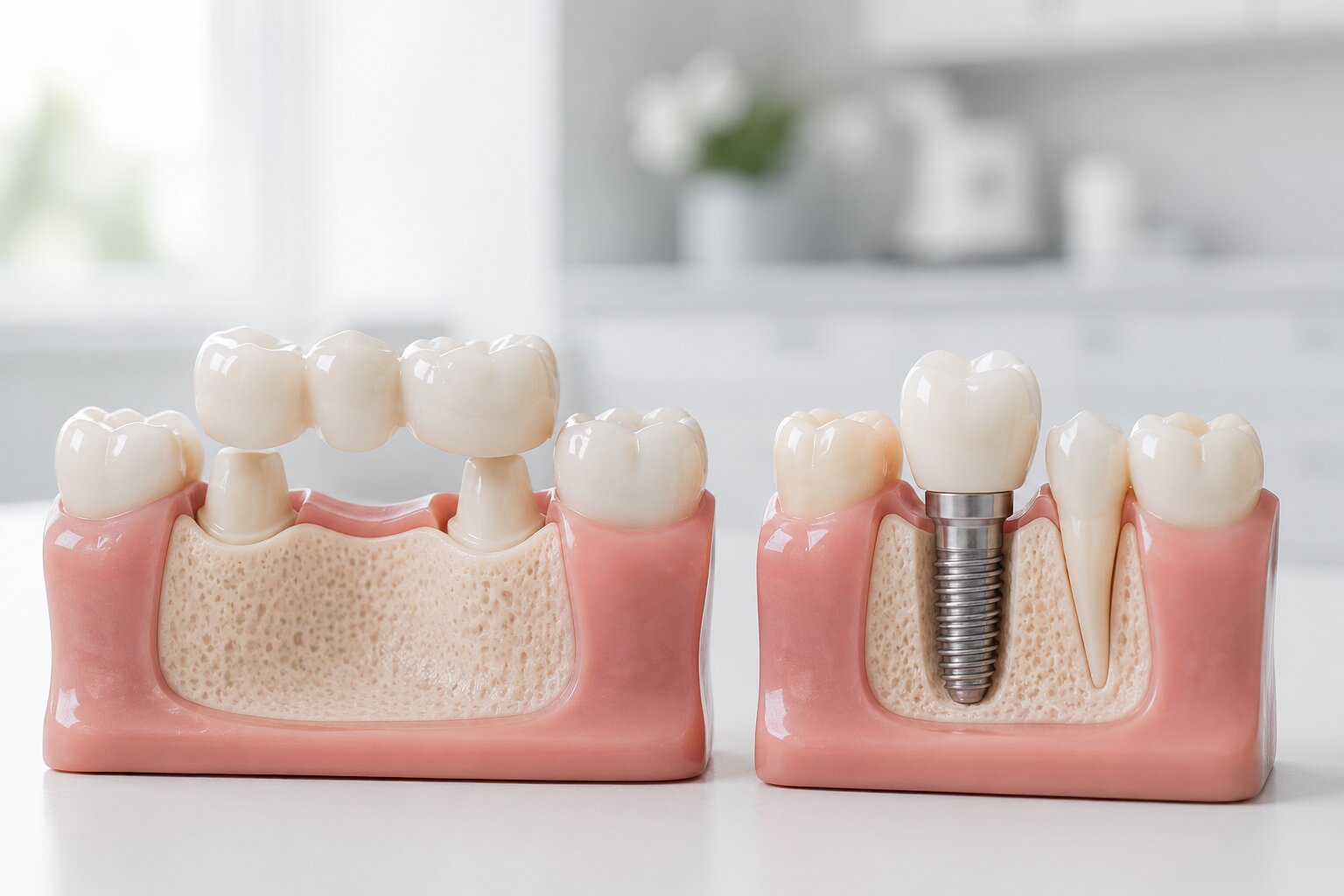
A dental bridge is a fixed restoration that literally bridges the gap left by a missing tooth. It consists of an artificial tooth — called a pontic — held in place by dental crowns that are cemented onto the two natural teeth on either side of the gap. Once fitted, it is permanent: you cannot remove it, and it looks and functions like a natural tooth.
The process is relatively straightforward. Your dentist prepares the two adjacent teeth by filing them down so that crowns can be fitted over them. Impressions are taken, a dental laboratory fabricates the bridge, and it is cemented in place — usually within two to three appointments over a few weeks.
Bridges are a well-established, non-surgical solution for replacing a single missing tooth or a short span of missing teeth.
What Is a Dental Implant?

A dental implant is a small titanium post that is surgically placed into your jawbone to act as an artificial tooth root. Once the implant integrates with the bone — a process called osseointegration that typically takes three to six months — a crown is attached to the top, creating a restoration that looks, feels, and functions like a natural tooth.
Implants are the only tooth replacement option that replaces the root as well as the crown. That distinction has significant consequences for your long-term oral health, as we explain below.
The treatment takes longer than a bridge — from initial consultation to final crown, the full process usually spans four to nine months — but the result is a standalone restoration that does not involve any other teeth.
The Key Differences
Impact on neighbouring teeth
This is one of the most important — and least discussed — differences between the two options. To place a bridge, the two healthy teeth on either side of the gap must be permanently filed down and crowned, even if there is nothing wrong with them. Those teeth will always require crowns from that point forward.
An implant, by contrast, is entirely self-contained. It stands alone in the jawbone and the adjacent teeth are left completely untouched.
Bone health
When a tooth is lost, the jawbone beneath the gap begins to shrink — a process called bone resorption. Over time, this can change the shape of your jaw and the appearance of your face.
An implant stimulates the jawbone in the same way a natural tooth root does, halting bone loss and maintaining your facial structure. A bridge sits above the gumline and does not address bone resorption at all. Over the years, the bone beneath the pontic will gradually deteriorate, which can create a visible gap between the bridge and the gum.
Longevity
Dental implants are designed to last a lifetime with proper care. Most patients can expect their implant to function for 25 years or more; many last indefinitely. Dental bridges typically last between 10 and 15 years before they may need replacing, as the supporting teeth and surrounding structures change over time.
Cost
A dental bridge has a lower upfront cost than an implant. In the UK, a bridge is typically priced from around £400 to £1,500 per unit, while a single implant generally costs between £2,000 and £3,500.
However, over a 20-to-25-year period, the calculation often favours the implant. A bridge that costs £1,500 and needs replacing every 10 to 12 years could cost considerably more over a lifetime — and that is before accounting for any work needed on the supporting teeth. An implant placed once, maintained well, and never replaced represents the lower lifetime cost in most cases.
Treatment time
A bridge can typically be completed within two to three weeks. An implant is a longer process — the surgical placement, healing period, and final restoration together span several months. If time is a priority, a bridge provides a faster route to a restored smile.
Surgical vs. non-surgical
For patients who are medically unsuitable for surgery, have significant bone loss, or who prefer to avoid a surgical procedure, a bridge may be the more appropriate choice. An implant requires a minor surgical procedure under local anaesthetic, and not every patient is a suitable candidate at the outset. In some cases where bone loss has occurred, a bone grafting procedure can rebuild sufficient density for implant placement — though this adds time and cost to the process.
Implants vs bridges: at a glance
Which option is right for you?
There is no universal answer — the right choice depends on several factors specific to your situation.
An implant is likely the better option if you are in good general health, have adequate bone density, and are looking for a long-term solution that protects the adjacent teeth and preserves your jawbone. For most patients who are suitable candidates, implants represent the superior clinical outcome over time.
A bridge is likely the better option if you need a faster result, have concerns about surgery, or if the adjacent teeth already have crowns or significant restorations — in which case using them as bridge supports makes clinical sense rather than unnecessary sacrifice.
The best way to understand which option suits your specific case is through a consultation with our team. We will assess your bone health, the condition of the surrounding teeth, and your overall oral health before making any recommendation.
What happens if you do nothing?
It is worth addressing this directly: leaving a gap after tooth loss is not a neutral decision. The adjacent teeth will gradually drift into the space, the opposing tooth may over-erupt, and bone resorption will begin beneath the gap. Over time, this affects your bite, your jaw health, and your facial appearance. Acting sooner rather than later — with whichever replacement option suits your circumstances — is almost always the right course.
Book a consultation at Lotus Dental Studio
Our team in Llanelli provides both dental implants and dental bridges for patients across South Wales, including Swansea, Gorseinon, Neath, and the surrounding areas. We will take the time to understand your goals and walk you through the options that make sense for you.
Lotus Dental Studio is based in Llanelli, South Wales, and serves patients across Carmarthenshire and the wider South Wales region. Services include dental implants, dental bridges, crowns, teeth whitening, veneers, Invisalign, and general dentistry.
Reviewed by Khawaja Jawad Fariduddin, BDS | Lotus Dental Studio