Professional teeth whitening typically lasts between one and three years — though how long your results hold depends almost entirely on lifestyle and how well you maintain them. It is one of the most common questions the team hears at Lotus Dental Studio, and the honest answer is that there is no single figure that applies to everyone. What you eat, drink, and how consistently you care for your teeth after treatment all play a significant role. This guide covers what shortens results, what extends them, and how to get the most from professional whitening in Llanelli and across South Wales.
How long does professional teeth whitening last?
Professional teeth whitening is not permanent, but results can last significantly longer than most people expect when maintained properly. In-practice whitening and dentist-prescribed take-home tray treatments both typically deliver results that hold for one to three years, and with periodic top-ups many patients extend this considerably. NHS guidance on teeth whitening confirms that while whitening is not permanent, following your dentist's advice can help results last around three years.
Over-the-counter strips and kits available in pharmacies tend to fade within weeks — not months — and rarely achieve the same level of brightness in the first place. At Lotus Dental Studio we offer both in-practice whitening and custom take-home trays, allowing patients across Carmarthenshire to choose the approach that best suits their schedule while still benefiting from clinically safe, regulated treatment.
What causes teeth whitening results to fade?
Discolouration after whitening is largely driven by what you consume and how you live day-to-day. Coffee, tea, and red wine are the most common culprits — their dark pigments bind to enamel over time and gradually dull the brightness achieved through treatment. Foods with strong colouring agents, such as berries, tomato-based sauces, and soy sauce, have a similar effect when consumed regularly.
Smoking is one of the fastest routes to reversing whitening results. Tobacco deposits tar and nicotine into the enamel surface and accelerates staining more than almost any dietary factor. Certain medications — particularly antihistamines, antipsychotics, and some blood pressure treatments — can also contribute to discolouration over time. Beyond lifestyle, natural ageing causes enamel to thin gradually, allowing the darker dentine layer beneath to show through. At our Llanelli practice, we discuss each patient's personal risk factors during their whitening consultation so that expectations are realistic from the outset.
How to make your teeth whitening results last longer
The 48 hours immediately following treatment are the most important window. Enamel pores remain open after whitening, making teeth more susceptible to staining during this period. Avoiding tea, coffee, red wine, and strongly pigmented foods in those first two days makes a meaningful difference to how long your results last. Using a straw for dark beverages beyond those initial 48 hours also reduces prolonged contact with the tooth surface.
A non-abrasive whitening toothpaste used twice daily helps remove surface stains before they settle. Regular hygienist appointments — ideally every six months — keep the tooth surface clean and free of build-up that would otherwise mask the whitening effect. For patients who have had custom take-home trays made, periodic top-up sessions of just a few nights every twelve to eighteen months are one of the most effective ways to preserve results without the cost or time of a full treatment course. Every patient at Lotus Dental Studio receives personalised aftercare guidance as part of their whitening treatment.
Professional whitening vs over-the-counter products — what's the difference in longevity?
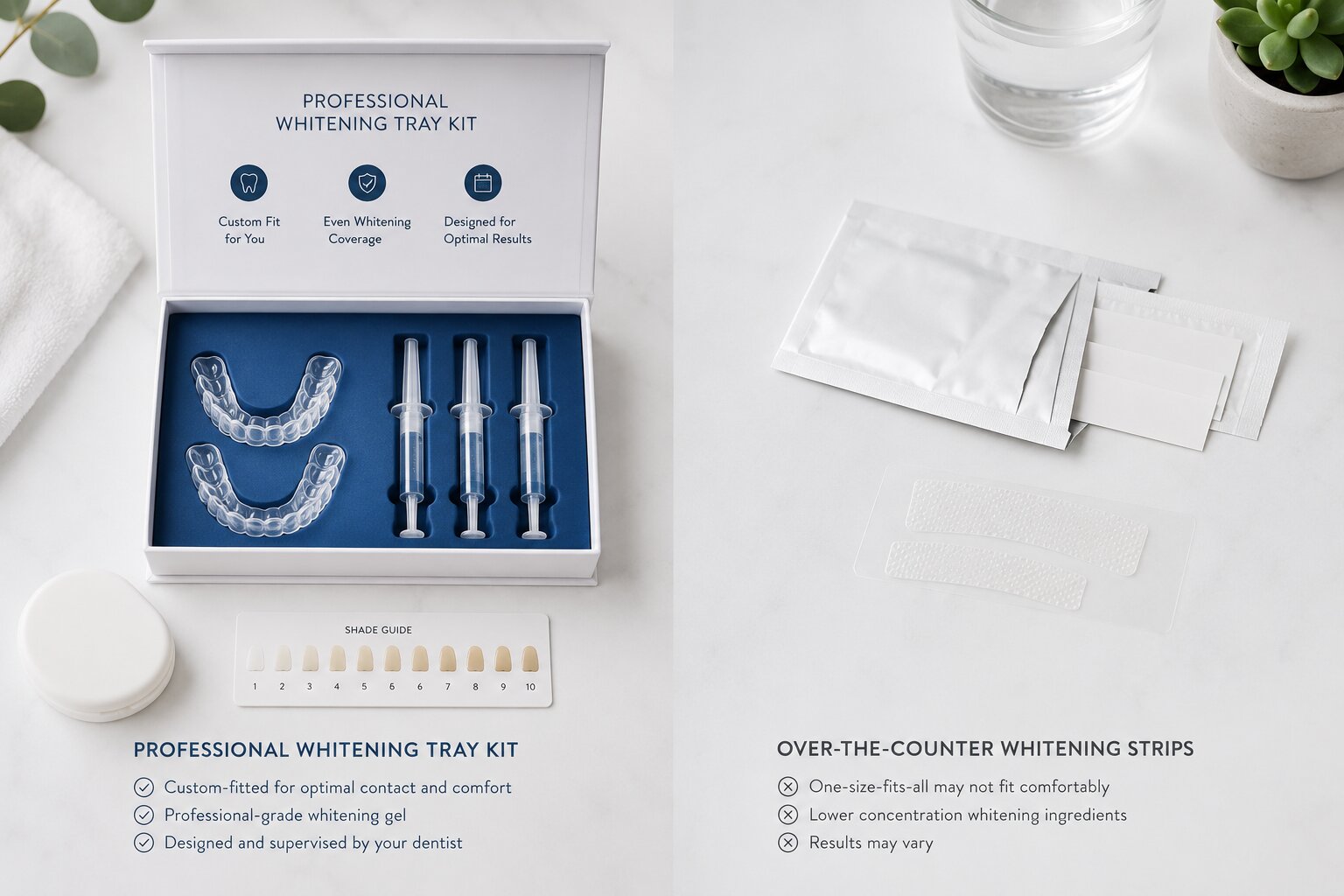
Comparison of professional teeth whitening kit and over-the-counter whitening strips at Lotus Dental Studio in Llanelli
The core difference is the concentration of the active whitening agent. Professional whitening uses hydrogen peroxide or carbamide peroxide at concentrations that are only legally permitted to be supplied by GDC-registered dental professionals in the UK. Over-the-counter products use substantially weaker concentrations, which limits both the depth of whitening achievable and how long any improvement remains visible.
This is not simply a matter of effectiveness — it is also one of safety. Non-dental providers such as beauty salons are prohibited by UK law from applying products at effective concentrations. Choosing professional teeth whitening at Lotus Dental Studio in Llanelli means treatment is carried out or directly supervised by a GDC-registered dentist, with properly fitted trays, the appropriate gel concentration, and full aftercare support included.
When is it time for a top-up?
Most patients notice a gradual dulling of their results rather than a sudden change. A top-up is worth considering when brightness has visibly reduced — typically around twelve to eighteen months after the original treatment, though this varies by diet and lifestyle. For those who have had custom trays made, top-ups are straightforward: a small amount of whitening gel used at home over a few evenings is usually sufficient to restore results, and is considerably more cost-effective than starting a full course from scratch.
Is teeth whitening right for everyone?
Teeth whitening works on natural tooth enamel and will not alter the shade of crowns, veneers, or existing restorations. If your concern involves discolouration alongside changes in shape or texture, composite bonding can address discolouration alongside shape and texture concerns where whitening alone is not the right solution. Patients with active gum disease, significant sensitivity, or untreated decay should have these issues resolved before proceeding — a pre-treatment check-up ensures whitening is appropriate and sets the best foundation for lasting results. Our guide to what composite bonding involves and whether it suits your needs is a useful companion read if you are weighing up cosmetic options.
Ready for a brighter smile that lasts?
If you are considering teeth whitening in Llanelli or across South Wales, the team at Lotus Dental Studio can advise on what results to expect and how to maintain them. Call 01554 774 509 or book an appointment online.
Lotus Dental Studio · 13 Llwynhendy Road, Llanelli, SA14 9DP · 01554 774 509
Reviewed by Khawaja Jawad Fariduddin, BDS | Lotus Dental Studio