Reviewed by Khawaja Jawad Fariduddin, BDS | Lotus Dental Studio
Reading time: 5 minutes
If you've been told a dental bridge could replace your missing tooth, you might be surprised to learn there isn't just one kind. The right type depends on where the gap is, how many teeth are missing, and the condition of the teeth nearby. Here's a straightforward guide to the main options.
What Is a Dental Bridge?
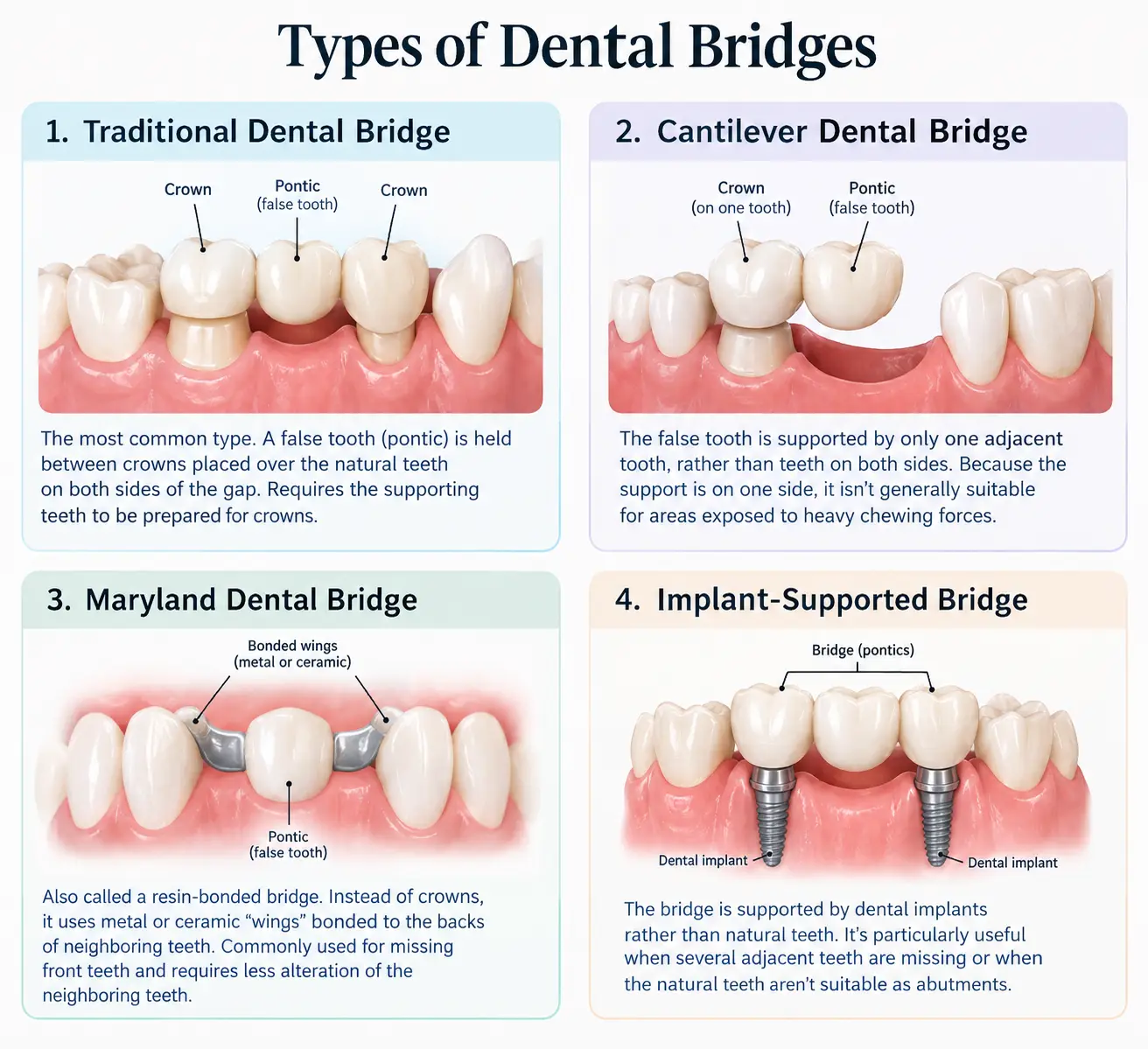
A dental bridge is a fixed restoration that "bridges" the gap left by one or more missing teeth. It's made up of one or more artificial teeth, called pontics, held securely in place by the teeth or implants on either side of the gap. Unlike a denture, a bridge isn't removable, it's fitted permanently and functions much like your natural teeth.
Traditional Dental Bridge
This is the most common type and the one most people picture when they hear "dental bridge." A crown is fitted on each of the two healthy teeth either side of the gap, and the artificial tooth sits suspended between them.
Best suited to: patients with healthy, strong natural teeth on both sides of the missing tooth, including back teeth where chewing forces are higher, since a traditional bridge is strong enough to handle that load.
Cantilever Dental Bridge
A cantilever bridge works in a similar way to a traditional bridge, but is anchored to only one neighbouring tooth rather than two. This makes it a useful option when there's only a healthy tooth on one side of the gap.
Because the entire bite force rests on a single anchor tooth, cantilever bridges are generally reserved for areas with lighter chewing pressure, most often front teeth, rather than the back of the mouth.
Best suited to: situations where only one adjacent tooth is healthy enough to support a bridge, typically towards the front of the mouth.
Maryland Bridge (Resin-Bonded Bridge)
A Maryland bridge takes a more conservative approach. Instead of full crowns, it uses a thin metal or porcelain framework with wings that bond directly to the back of the neighbouring teeth. This means little to no alteration of the healthy teeth either side, which some patients prefer.
The trade-off is durability. Maryland bridges aren't designed to withstand heavy chewing forces, so they're generally used for front teeth rather than molars, and the bonded wings can occasionally need rebonding over time.
Best suited to: replacing a single front tooth where preserving the adjacent teeth's structure is a priority.
Implant-Supported Bridge
Rather than relying on natural teeth for support, an implant-supported bridge is anchored to one or more dental implants placed in the jawbone. This avoids putting any load on natural teeth altogether, and tends to offer the most stability of the four options.
This approach is often considered when several teeth in a row are missing, or when the neighbouring natural teeth aren't healthy enough to support a traditional bridge on their own.
Best suited to: replacing multiple missing teeth in a row, or situations where you'd rather not involve healthy adjacent teeth in the restoration at all.
How Does Your Dentist Decide Which Type Is Right for You?
A few factors typically guide the decision:
- Where the gap is. Front teeth carry less chewing force than back teeth, which opens up more options.
- The condition of neighbouring teeth. Healthy, strong teeth either side make a traditional bridge straightforward. Compromised or missing teeth on one side point towards a cantilever or implant-supported approach.
- How many teeth are missing. A single gap has more options than several teeth in a row.
- Your priorities. Some patients prioritise preserving healthy tooth structure, others prioritise long-term durability, and the right bridge type reflects that.
Your dentist will talk through these factors with you at your consultation, alongside X-rays or scans to assess what your remaining teeth and jawbone can support.
Bridge or Implant? A Different Question
Choosing a type of bridge is a separate decision from choosing between a bridge and a dental implant in the first place. If you're still weighing up which approach suits your situation overall, our guide on how dental bridges compare to implants walks through that comparison in detail.
How Long Does a Bridge Take to Fit?
Most bridges, aside from implant-supported ones, are completed over two appointments. At the first, the supporting teeth are prepared and impressions are taken. At the second, usually a couple of weeks later once your bridge has been custom-made, it's fitted, checked, and adjusted for a comfortable bite.
If a crown is also being placed on a supporting tooth as part of the process, our guide to dental crowns covers what that involves.
Ready to Talk Through Your Options?
Every gap is a little different, and the right type of bridge depends on your specific case. If you're considering dental bridges in Llanelli, book a consultation with our team and we'll assess which option genuinely suits your situation.
Lotus Dental Studio, 13 Llwynhendy Road, Llanelli, SA14 9DP · 01554 774 509