It is one of the most common decisions people put off. A tooth is extracted, often a molar at the back, and because no one can see the gap, life carries on as normal. You tell yourself you will deal with it eventually. Weeks become months. Months become years.
The problem is that while you are waiting, your body is not. A missing tooth sets off a chain of physical changes that begins almost immediately and becomes progressively harder and more expensive to reverse. This post explains exactly what happens, why the timeline matters, and what your options are at Lotus Dental Studio in Llanelli.
Why a Missing Tooth Is More Than a Gap in Your Smile
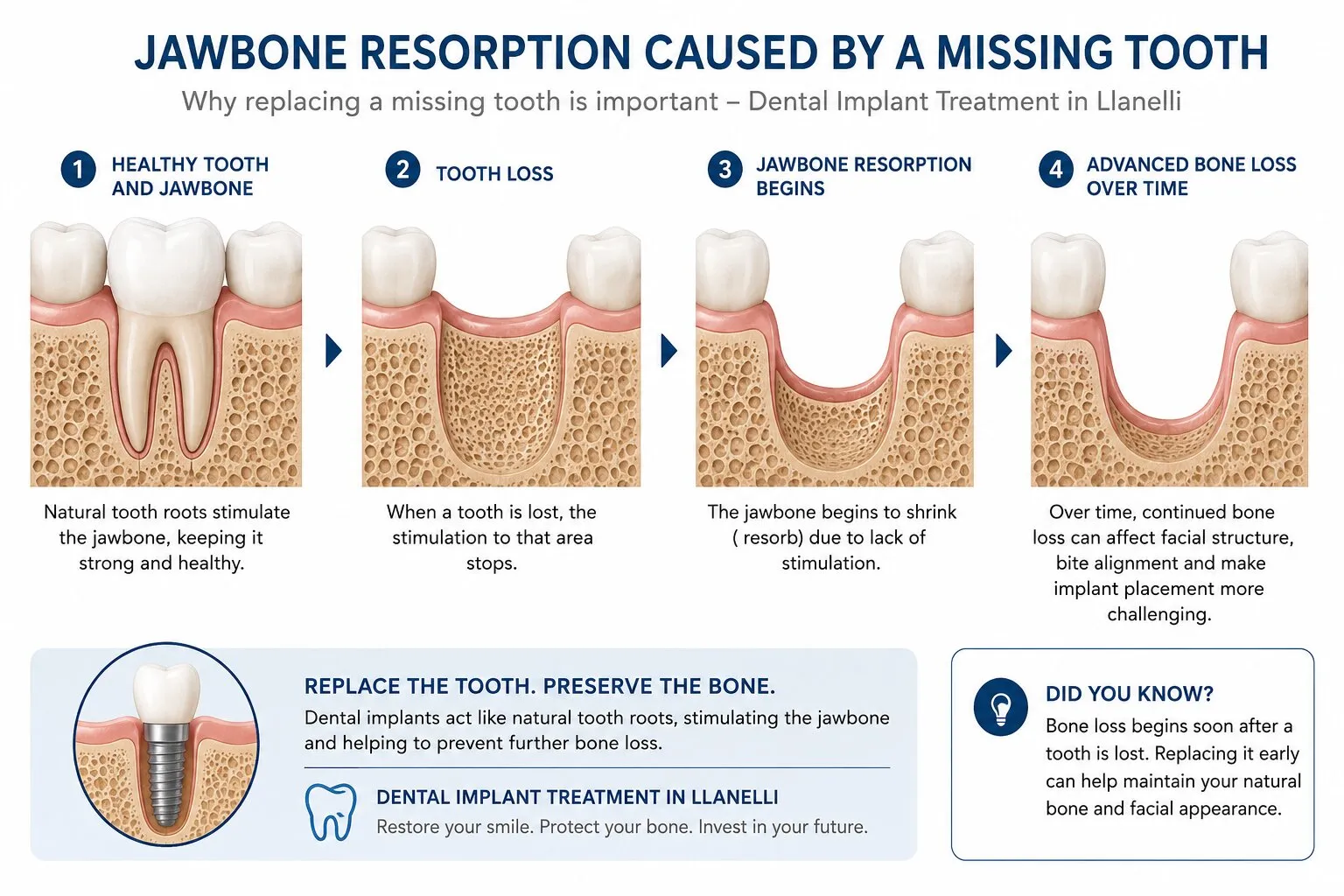
Your tooth root does more than anchor your tooth in place. Every time you bite and chew, the root transmits pressure into the surrounding jawbone, and that stimulation is what keeps the bone healthy and dense.
When a tooth is lost, that stimulation stops. The jawbone beneath the gap no longer receives the signal to maintain itself, and it begins to resorb, gradually shrinking in width and height. Think of it like a muscle that is never used: without regular demand placed on it, it diminishes over time.
This process of bone resorption is the underlying mechanism behind almost every other consequence that follows from an untreated missing tooth.
How Bone Loss Progresses and Why the Timeline Matters
Bone resorption does not wait. Research consistently shows that measurable bone loss begins within the first few weeks after a tooth is extracted. Within the first year, a significant amount of bone volume can be lost at the site of the missing tooth.
This matters most if you are considering a dental implant. Implants require adequate bone volume and density to be placed successfully. The longer you leave a gap untreated, the more bone is lost, and the more likely it becomes that a bone graft would be needed before an implant can be placed.
Bone grafting is a well-established procedure, but it adds time, complexity, and cost to treatment. Patients who act within three to six months of losing a tooth often have significantly more options and simpler treatment paths than those who wait several years.
Getting a consultation early does not commit you to immediate treatment. But it does mean a dentist can assess your bone levels now, advise on the right timing, and ensure your options remain as straightforward as possible.
The Knock-On Effects You Might Not Expect
Bone loss is the silent consequence, the one most patients never see coming. But there are several other effects that tend to develop alongside it, and most are equally easy to overlook until they become a problem.
Neighbouring Teeth Begin to Drift
Teeth maintain their position partly because of the support they receive from adjacent teeth. When one is lost, the teeth on either side gradually tilt towards the gap. The tooth above or below, the opposing tooth, may also begin to over-erupt, growing downward or upward into the space.
Over time this changes the alignment of multiple teeth, makes cleaning harder, and can eventually require orthodontic treatment to correct. All of this could have been avoided by replacing the missing tooth.
Your Bite Changes and Your Jaw Follows
As teeth drift and shift, the way your upper and lower teeth meet changes. Contact points that previously distributed bite force evenly across the mouth become uneven. This places excess pressure on remaining teeth and on the jaw joint itself.
For some patients this leads to jaw pain, clicking, headaches, or the early stages of temporomandibular joint (TMJ) dysfunction. These are problems that can be difficult and time-consuming to treat once established.
Your Face Shape Can Change
The jawbone does not just support your teeth. It supports the soft tissue of your lower face. As bone volume reduces at the site of a missing tooth, the overlying gum and facial tissue loses some of its structural foundation.
With a single missing tooth this change is subtle, but with multiple missing teeth it becomes more visible: a sunken or prematurely aged appearance around the lower face and cheeks. It is a less-discussed consequence of tooth loss, but it is a real one, particularly relevant for patients who are already thinking about the cosmetic side of their smile.
Chewing Becomes Harder and Eating Habits Change
Most people adapt to a missing tooth without noticing. They shift chewing to the other side of the mouth, avoid certain foods, or cut things differently. The problem is that this adaptation places extra wear on the teeth doing all the work, and dietary changes that avoid harder foods over a long period can have nutritional implications, particularly for older patients.
Your Remaining Teeth Are Under More Pressure
A full set of teeth distributes the forces of biting and chewing across the entire arch. Each tooth carries its share of the load. When one is missing, that load is redistributed, and the teeth left to pick up the slack experience accelerated wear, increased fracture risk, and greater strain over time.
Replacing a missing tooth is not just about the gap itself. It protects the teeth you still have.
Does It Matter Which Tooth Is Missing?
A common assumption is that back teeth, molars and premolars, do not need replacing because nobody can see them. This is understandable, but it is not clinically accurate.
Molars bear the majority of the chewing load in your mouth. Losing a molar without replacing it accelerates bone resorption and bite imbalance at a faster rate than losing a front tooth in many cases, precisely because of the forces involved. The consequences described above, tooth drift, bite change, increased wear on remaining teeth, all occur regardless of whether the missing tooth is visible or not.
Front teeth carry their own implications: they affect speech, they are immediately visible, and their loss tends to prompt faster action. But the absence of a visible gap does not mean the absence of a problem.
How Long Can You Wait Before Replacing a Missing Tooth?
There is no universal deadline, and the right time to replace a missing tooth depends on your individual circumstances. But the clinical consensus is clear: earlier is better.
Implant placement within three to six months of extraction typically produces better outcomes than placement after several years of bone loss. The sooner a dentist can assess your situation, the more options remain available to you, and the simpler, faster, and less costly treatment tends to be.
If you have had a tooth extracted recently, or if you have been living with a gap for some time, the most useful thing you can do right now is book a consultation. Even if treatment is not immediate, having your bone levels assessed early ensures you are not inadvertently closing off options by waiting.
What Are Your Options for Replacing a Missing Tooth?
There are three main routes for replacing a missing tooth, and they are not all equal in terms of their long-term effect on your jawbone.
Dental implants are the only replacement option that addresses bone loss directly. The implant post is placed into the jawbone, where it functions as an artificial root, restoring the stimulation the bone needs to maintain its volume and density. For most patients, implants are the closest thing to a natural tooth that modern dentistry can offer. You can read more about dental implants at Lotus Dental Studio in Llanelli on our dedicated treatment page.
Bridges are fixed restorations that span the gap using the adjacent teeth as anchors. They restore function and appearance effectively, but because there is no root in the jawbone, bone resorption continues beneath the bridge. If you are weighing up the two options, our post on how implants compare to bridges covers the difference in depth.
Dentures are a removable option that can replace one or several teeth. Like bridges, they sit above the gumline rather than in the bone, so they do not prevent resorption. Modern dentures are more comfortable and natural-looking than their reputation suggests, but for most patients with a single missing tooth, a fixed solution tends to be preferable for everyday function and long-term bone health.
Am I a Good Candidate for a Dental Implant?
Not everyone is immediately suitable for a dental implant. Factors including overall health, bone volume, and smoking history all play a role in candidacy. But many patients who assume they are not eligible find out at their first consultation that they are. The only reliable way to know is to be properly assessed.
If you have been putting off looking into implants because you are not sure whether they are an option for you, our post on whether you are a candidate for dental implants is a useful starting point, and a consultation with the team at Lotus Dental Studio will give you a definitive answer for your specific situation.
A missing tooth is not a problem that stays the same while you think about what to do. The bone loss, the tooth drift, the bite changes all accumulate quietly in the background, and the longer treatment is deferred, the more complex and costly the path back tends to be.
The good news is that acting early keeps your options open. Lotus Dental Studio offers implant consultations for patients across Llanelli, South Wales, and Carmarthenshire. Whether you lost a tooth recently or have been living with a gap for years, the right time to get it assessed is now.
Book Your Implant Consultation Book online at lotusdental.co.uk or call 01554 774 509
Clinically reviewed by Khawaja Jawad Fariduddin, BDS | Principal Dentist at Lotus Dental Studio, Llanelli. GDC registered.